Best Apps for Couples Who Speak Different Languages (2026)
A practical guide to the apps that actually help cross-language couples communicate — from real-time voice translation to shared journaling tools.
Heartline
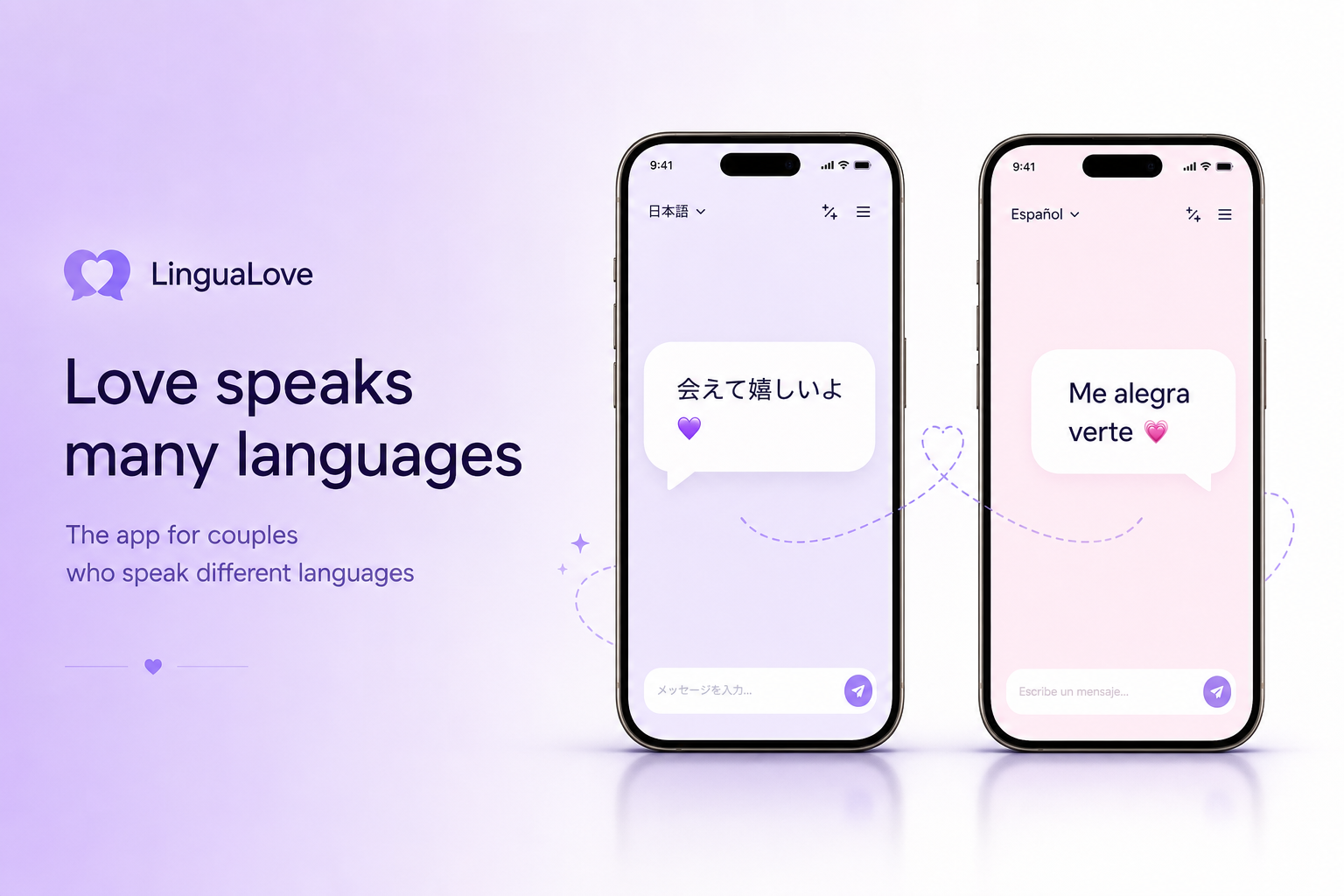
Two people. Two languages. One relationship. If that sounds like your situation, you’ve probably tried every translation hack in the book — copy-pasting messages into Google Translate, muddling through voice notes, struggling through video calls that feel more like charades than conversations.
The good news: apps have gotten dramatically better at closing this gap. Here’s a clear-eyed look at the tools that genuinely help cross-language couples connect — and what each one is best for.
What Cross-Language Couples Actually Need
Before diving into the list, it’s worth naming the problem specifically. The challenge isn’t just translation — it’s continuity of connection. You need:
- Instant text translation that doesn’t interrupt the flow of a conversation
- Voice calls where both people can speak naturally in their own language
- Video calls that still feel intimate, not clinical
- A way to express nuance, emotion, and humor — not just literal meaning
Most general-purpose translation apps solve one of these. Very few solve all of them.
Heartline — Built Specifically for Couples
Best for: Everything. Text, voice, and video — all in one place.
Heartline was designed from the ground up for people in cross-language relationships. The core insight: a relationship app needs translation baked in, not bolted on.
What it does well:
- Real-time voice calls with live interpretation. You speak in your language; your partner hears you in theirs, with minimal delay. It’s not perfect — no real-time translation is — but it’s close enough to have a real conversation.
- Video calls with live subtitles. As you speak, subtitles appear on your partner’s screen. You can see each other’s face while still following the meaning.
- Instant text translation. Messages are translated automatically in the chat thread. You can always tap to see the original, so nothing gets lost.
- Supports 100+ languages, including Japanese, Korean, Chinese, Spanish, French, German, Portuguese, Vietnamese, Russian, Ukrainian, and more.
If you’re in a committed cross-language relationship and want one app that handles everything, Heartline is the most complete solution available.
Download Heartline on the App Store
Google Translate — The Universal Fallback
Best for: Quick one-off translations when you don’t want to switch apps.
Google Translate is the most widely used translation tool in the world, and for good reason. The quality is solid for the major language pairs, and it handles text, voice, images, and even a live camera mode.
Where it falls short for couples:
- It’s not built as a communication tool. You paste text in, get text out. There’s no ongoing conversation thread.
- Voice calls and video calls don’t exist — it’s purely a translation utility.
- For anything longer than a quick message, the workflow gets clunky.
Use it when: You’re traveling together, reading a menu, or translating a quick phrase. Don’t rely on it for your primary couple communication.
DeepL — Best Text Translation Quality
Best for: Written communication where translation accuracy matters most.
DeepL consistently outperforms other translation engines for European languages in particular. The translations feel more natural and idiomatic — less robotic.
Where it falls short:
- No real-time voice or video features.
- The free tier has limits; the paid version is designed for business users, not couples.
- Like Google Translate, it’s a utility, not a relationship communication tool.
Use it when: You want to write a thoughtful message and you want it to land with real nuance in your partner’s language.
WhatsApp — With Manual Translation
Best for: Couples already using WhatsApp who don’t want to switch platforms.
WhatsApp added a basic in-chat translation feature in some regions, though it’s still limited. Practically, most couples use it by copying messages into a separate translation app, which is disruptive.
Where it falls short:
- The translation feature isn’t available everywhere and only covers some languages.
- Voice calls are not translated — you’re on your own.
- There’s no purpose-built cross-language experience.
Use it when: Both of you are already on WhatsApp and you’re using it alongside a dedicated translation tool.
Microsoft Translator — Best for Group Conversations
Best for: Moments when you’re with each other’s families or in a group setting.
Microsoft Translator has a useful “conversation” mode where multiple people can join a shared session from their own phones and each sees messages in their language. It’s genuinely impressive in group settings.
Where it falls short:
- Not designed for ongoing couple communication.
- The interface isn’t built for intimacy or regular use.
- No real-time voice call translation.
Use it when: You’re meeting your partner’s family and want everyone to be able to communicate.
The Honest Bottom Line
If you’re serious about making a cross-language relationship work, the right tool isn’t a general-purpose translator — it’s a communication platform that treats language translation as a first-class feature, not an afterthought.
For most couples, the practical stack looks like this:
- Heartline for day-to-day communication — text, voice, and video calls
- DeepL for writing thoughtful messages in your partner’s language
- Microsoft Translator for group situations with family or friends
The technology has caught up to the reality that love doesn’t always pick someone who speaks your language. The apps have too.
Heartline is available free on iOS and Android, with optional premium features for unlimited calls and advanced AI conversation tools.