Sofia & Kenji: The Relationship That Started With Wrong-Language Voice Messages
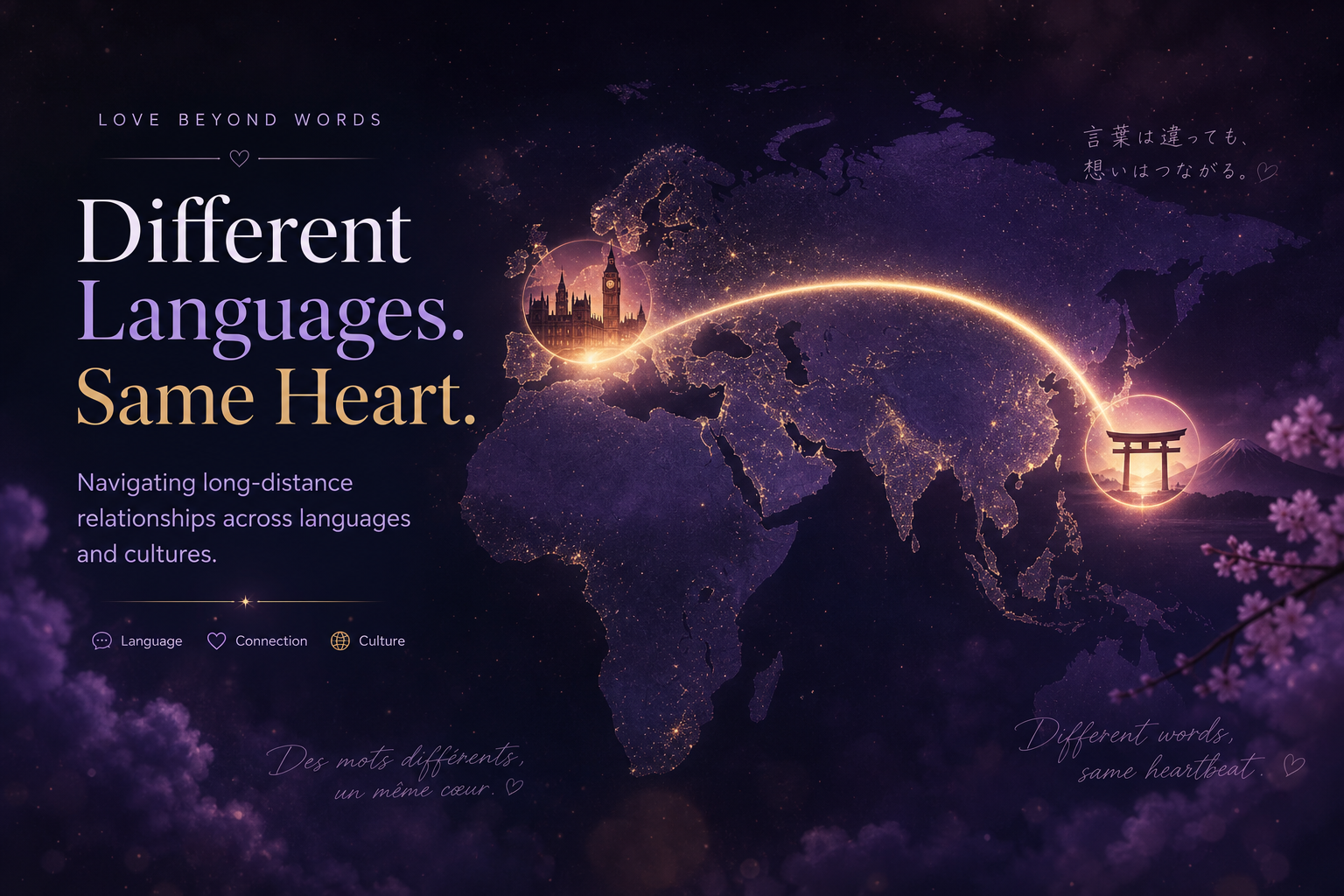
She was in Madrid. He was in Osaka. Neither spoke the other's language. What happened next took both of them completely by surprise.
Heartline Stories

Sofia Romero had been studying Japanese for eight months when she downloaded Heartline. Not because she thought she’d meet anyone — she was still conjugating verbs in her head before speaking — but because she wanted somewhere to practice with native speakers who weren’t in a classroom.
Kenji Nakamura was using the app for almost the opposite reason. His English was solid, built over years of studying it for his software engineering job. But English felt thin to him. Functional. He wanted to talk to someone the way he actually talked — in Japanese, about real things.
He sent Sofia a voice message. In Japanese. She sent one back. In Spanish.
Neither of them understood a word the other said. Heartline translated both messages, automatically, as they arrived.
The First Week
“I think the first thing I actually understood about him,” Sofia says, “was the tone of his voice before I understood the words.”
She’s describing the strange experience of receiving a translated voice message — hearing a voice you don’t understand, reading the translation in your own language, and somehow getting both pieces of information at once. The warmth in a voice. The exact words, separated by a moment.
“It makes you pay more attention,” she says. “You can’t tune out.”
Kenji was disoriented at first by the Spanish. “It’s such an expressive language. Even translated, I could tell she was enthusiastic. She was always enthusiastic.”
They spent the first week exchanging voice messages that neither could understand without the translation layer. By day four, Kenji started listening to her messages twice — once with the translation visible, once without, just for the sound of it.
The First Call
Six days in, Kenji asked if she wanted to try a voice call.
Sofia said yes before she could second-guess it.
“The first thirty seconds were chaotic,” she laughs. “He said something, I heard Spanish, he heard Japanese. We were both laughing before we understood why.”
The real-time translation on Heartline has a small delay — the system needs a moment to process and convert the speech. Those small pauses became, in their telling, one of the unexpected gifts of the early relationship.
“We had to be patient,” Kenji says. “You couldn’t interrupt each other. You had to wait. And in that waiting, you actually listened.”
They talked for three hours that first night. Kenji fell asleep at 2 AM Osaka time with his phone still on, Sofia’s voice still in the earpiece, now quietly translated into Japanese, drifting through what he would later describe as one of the strangest and most peaceful nights of his life.
Learning Each Other’s Words
Sofia started learning Japanese more seriously after the third week. Not because she felt pressure to — Heartline was handling the communication fine — but because she wanted to hear Kenji understand her directly.
“I learned how to say ‘I like talking to you’ in Japanese. I practiced for two days. I said it to him on a call and he went completely quiet.”
Kenji, for his part, began learning Spanish phrases with a focus that surprised his coworkers. He had a small notebook he carried. His colleagues assumed he was studying for work.
Four months in, their calls were a mix: Japanese when Kenji felt the need for precision, Spanish when Sofia was excited, English as a kind of neutral ground when neither wanted the translation layer between them. Heartline was still there for the moments when they fell back on their native languages. But it was used less.
Meeting in Person
They met in person in Lisbon — chosen because neither of them had been there, making it equally unfamiliar ground.
“I was terrified,” Sofia admits. “Online, you have time. In person, you say something wrong and there’s no translation app that can cover the silence.”
Kenji had prepared differently. He’d learned a specific thing to say in Spanish — something he’d written, revised, and memorized — for the moment they first saw each other at the airport.
He said it. She cried.
“I still won’t tell you what it was,” she says. “But it wasn’t complicated. That was what got me. He’d worked so hard to say something simple.”
Where They Are Now
Sofia and Kenji have been together for fourteen months. Kenji is planning to spend a year in Madrid. Sofia has started an informal Japanese language blog — originally for herself, now with a small following of other people navigating cross-language relationships.
They still use Heartline. Not because they need it the way they once did, but because on certain evenings, one of them will switch back to their native language — fully, unselfconsciously — and let the other hear them the way they actually are.
“There’s something about hearing someone in their real language,” Kenji says, “even when you don’t understand it. You hear a different person. The full person.”
Sofia nods. “You fall in love with the voice before you fall in love with the words.”
Heartline provides real-time translation for text, voice, and video calls — built for people who found connection across language barriers. Download on iOS and Android.