Table of contents
Every cross-language couple starts with Google Translate. It's free, it's installed in two minutes, and for the first few weeks it feels like magic. Then, somewhere between the honeymoon phase and the first real argument, it starts failing in ways that are hard to name.
Let's name them. To be fair first: Google Translate is genuinely excellent at what it was built for, which is translating text you hand it. Menus, signs, documents, a paragraph from an article, one unfamiliar word. Keep it installed forever. The problems only start when it becomes the channel your relationship runs through — because a relationship isn't a stack of sentences, and that's the only shape Google Translate understands. (We keep a full side-by-side comparison if you want the short version.)
The copy-paste loop quietly shrinks your relationship
Count the steps in one translated text exchange: read her message, fail to understand it, copy, switch apps, paste, read the translation, compose your reply in English, translate it, copy the output, switch back, paste, send. Twelve steps. Per message.
The cost isn't effort. It's rhythm. Banter dies in a twelve-step pipeline. The joke lands two minutes late, so it doesn't land. And the little messages, the "thinking of you," the photo of a dog that looks like her dog, stop getting sent at all, because each one now costs a workflow. Couples in this loop text measurably less over time, and the relationship thins without anyone deciding anything.
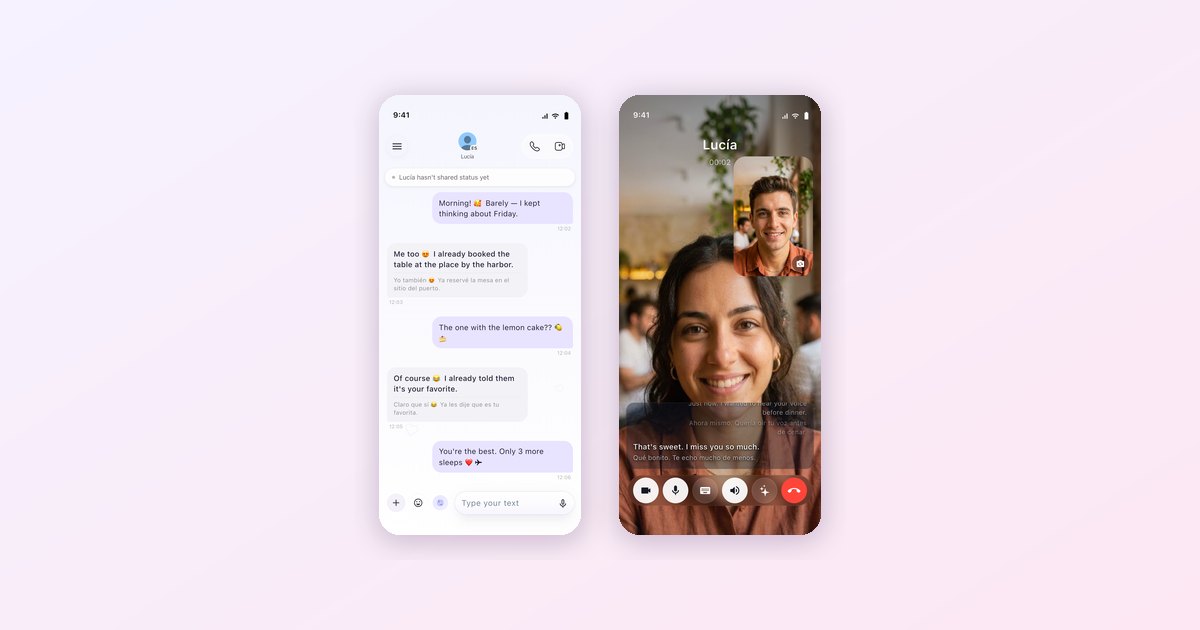
That, more than any single feature, is why apps built for cross-language couples exist: translation has to live inside the conversation. You type in your language, they read in theirs, both versions in the same bubble, zero extra steps. What the switch buys back is the rhythm.


Tone doesn't survive the trip
Google Translate optimizes for literal accuracy, and in intimate conversation literal accuracy is often the wrong target. Some real failure patterns:
Softeners vanish. "Maybe we could stay home instead?" becomes "We stay home." A gentle suggestion arrives as a command, and your partner wonders when you got so cold.
Formality misfires. In languages with politeness registers, Japanese and Korean most famously, the engine often defaults formal. Six months in, your sweetest message shows up sounding like a business email.
Sarcasm and idioms translate literally, with predictable results. "Break a leg" has genuinely ended conversations.
And nicknames get "corrected." To a general-purpose engine, your inside-joke pet name is a typo to fix or a noun to translate. There goes 汤圆. There goes "bug." These are exactly the fights-out-of-nowhere that make cross-language couples think they have a communication problem when they have a tooling problem.
None of this is a bug in Google Translate. It's doing precisely what a general-purpose translator should. It's just the wrong instrument for a love letter.
The hard wall: it can't do calls
This one is a capability gap rather than a quality gap. Google Translate's conversation mode is built for two people sharing one phone, a tourist asking directions. It cannot sit between two phones in two countries and translate a call.
For long-distance couples, voice and video are the relationship, so this wall matters more than everything above it. The workarounds are all bad: speaking slow simplified English until the weaker speaker tires out and goes quiet, or typing into a translator mid-call while nobody looks at anybody's face.
Live-translated calls are the actual fix. Each person speaks their own language, and subtitles in both languages render in real time, on the call itself. You watch your partner, not an app. Heartline does this for voice and video. Google Translate doesn't, because it was never the job it was built for.
It also doesn't know you two
Every Google Translate request starts from zero. It doesn't know that "the thing on Saturday" is her sister's wedding, or that "potato" means I love you because of something that happened in 2024. Relationships accumulate private context; a stateless translator can hold none of it. A purpose-built channel can — Heartline's Relationship AI will even help you find words ("how do I apologize properly?") rather than just converting the ones you already typed.
So what's the actual setup?
Simple, and it's the rule from our cross-language playbook: lookup tools for the world, a real-time channel for each other. Google Translate for the menu, the visa form, the news article in her language. Heartline for the two of you — texts, calls, video, the conversation at the center of all of it.
Use each for what it's for, and stop asking a dictionary to carry a relationship.
Heartline provides real-time translation for text, voice, and video calls — built specifically for cross-language couples. Available free on iOS and Android.
Frequently asked questions
Is Google Translate good enough for a cross-language relationship?
For lookups, yes — menus, signs, single words, one-off sentences. As the channel your relationship runs through, no: the copy-paste loop kills conversational rhythm, tone gets stripped, and it can't translate live voice or video calls between two phones.
Why do my translated messages sound cold to my partner?
General-purpose translation optimizes for literal accuracy, not emotional register. Softeners vanish ('maybe we could...' becomes a flat command) and politeness levels misfire. In intimate conversation, tone is most of the message — and it's the first thing lost.
Can Google Translate translate a phone or video call?
No. Its conversation mode is designed for two people sharing one phone in person. It cannot translate a call between two phones in two countries. Live-translated calls with subtitles for both sides require a purpose-built app like Heartline.
What happens to nicknames and inside jokes in Google Translate?
They get 'corrected' or translated literally — a general-purpose engine treats your pet name as a typo or a dictionary word. Purpose-built couple channels keep both originals visible, so private language survives translation.
Should I stop using Google Translate entirely?
No — keep it for the world outside your relationship: documents, menus, signs, quick lookups. The rule of thumb: lookup tools for the world, a real-time translated channel for each other.

Try Heartline for free
Love speaks every language. Text, voice and video — translated in real time.