Table of contents
Somewhere around month three, every cross-language couple has the same fight. Not the same topic, the same shape. It starts small, escalates weirdly fast, and ends with one person silent and the other convinced the silence means something it doesn't.
It's worth understanding why this happens mechanically, because once you see the machinery, most of it stops working on you.
Why the fights escalate
Three things stack on top of whatever you're actually fighting about.
Nuance goes first. In your native language you can be upset and precise at the same time: "I'm not angry, I'm disappointed, and mostly I'm tired." Under adrenaline, in a second language, that collapses into "I'm fine" or into blunt words that overshoot. Your partner responds to the overshoot, not the intent, and now you're both escalating a misunderstanding.
Translation strips tone. A softened sentence like "maybe we could stay in tonight instead?" comes out the other side as a flat "we stay home." One of you was being gentle; the other one heard a command. Now you're fighting about the tone of a translation on top of the original issue.
And fluency becomes power. Whoever's language you're arguing in has home-field advantage: faster words, less mental load. The other partner eventually goes quiet, not from agreement but from exhaustion. Silence gets read as stonewalling. It almost never is.
Name these three patterns together, on a calm day. Then when a fight starts bending out of shape, either of you can call it: "that's the translation, not me."
What actually keeps a fight fair
Slow the medium down. Speed feeds every failure mode above, so when things heat up, move to a deliberately slower channel: typed messages, or spoken sentences with real pauses. Agree in advance that slower doesn't mean colder.
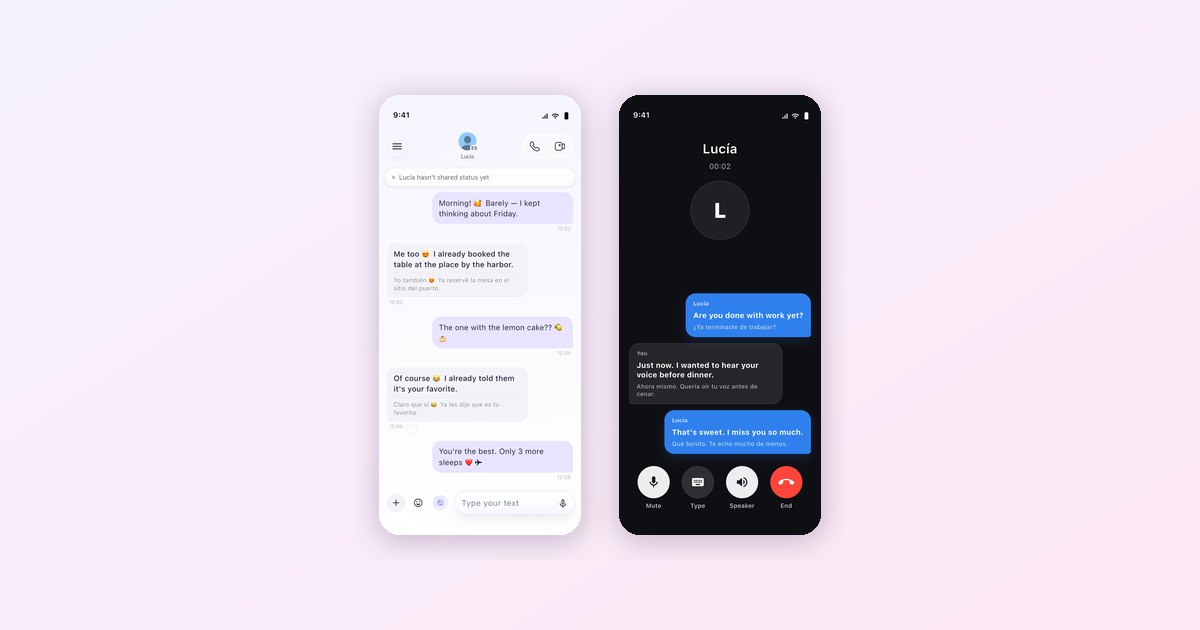
For anything heavier than dishes, write first. Each of you writes your side in your own native language, then shares it translated. Writing natively hands you back your full range; you finally get to argue as yourself instead of as your B1-level self. In Heartline both the original and the translation sit in the same bubble, so your partner can point at a specific phrase and ask what you meant by it.
Never argue only in the fluent partner's language. Alternate, or better, let live translation carry a voice call while each of you speaks your own language. The subtitles keep up; the power stays level.
Drop sarcasm entirely until you've made up. Sarcasm survives translation approximately never. "Oh great, perfect" arrives as either sincere approval or pure confusion, and neither helps you. Same for idioms and pet names mid-conflict; we've catalogued what translation does to those elsewhere.
And adopt one shared phrase, "check: did you mean X?", that either of you can throw when a sentence lands wrong. Nine times out of ten the offending sentence was a translation artifact.


Making up is the harder translation
Apologies are the most culture-loaded speech act there is, and nobody warns you. Some languages apologize in elaborate words. Others apologize through actions: tea gets made, the shelf finally gets fixed, someone shows up early. If your partner's apology doesn't look like yours, it may still be an apology. Ask before you conclude it isn't.
A repair sequence that travels across any language pair: cool down separately for an agreed amount of time, so distance can't be misread as abandonment. Then each of you writes three sentences in your native language, translated after. What I felt, what I needed, what I'm sorry for. Read them. Don't litigate the translations.
Then close it with voice, on a live-translated call or face to face. Text can end a fight, but it can't really end the feeling of one, and with live subtitles you each get to be warm in your own words. Long-distance couples: this step is not optional for you. Never let a real fight die on text alone.
One honest caveat
Language problems make fights worse. They rarely cause them. If the same conflict keeps returning in every language and every channel you try, the conflict is the message. Deal with it directly, ideally once the translation noise is out of the way.
The good news, from couples who've been at this a while: strip away the translation noise and what's left is a normal relationship with normal disagreements. Which is all any couple gets.
Heartline provides real-time translation for text, voice, and video calls — built specifically for cross-language couples. Available free on iOS and Android.
Frequently asked questions
Why do small disagreements become big fights in cross-language couples?
Three mechanical reasons: nuance collapses under stress in a second language, translation strips tone so gentle sentences arrive cold, and the partner arguing in their weaker language falls silent from cognitive overload — which gets misread as stonewalling.
Should we argue in one language or both?
Never only in the fluent partner's language — that gives one side home-field advantage. Either alternate, or let each partner speak their own language with live translation carrying it across, so the load and the fight stay even.
What's the 'write first, then talk' technique?
For anything serious, each partner writes their side in their own native language, then shares it translated. Writing natively restores your full expressive range — you argue as yourself, not as your second-language self. Keep both versions visible so either partner can ask about specific phrases.
How do we make up when apologies look different in each culture?
Apologies are culture-loaded: some languages apologize in words, others through actions. Cool down for an agreed duration, each write three native-language sentences (what I felt, what I needed, what I'm sorry for), translate and read them, then close with a live-translated call — voice carries warmth text can't.
How do I know if it's a language problem or a relationship problem?
Translation issues make fights worse but rarely cause them. If the same conflict repeats in every language and channel you try, the issue is the issue — address it directly, ideally with the language noise stripped away by good tools first.

Try Heartline for free
Love speaks every language. Text, voice and video — translated in real time.