Table of contents
A lot of people arrive at their first Korean relationship with a decent vocabulary of K-drama phrases. 사랑해. 보고 싶어. Maybe a well-timed 오빠. It's charming for about a week, and then the actual relationship starts, and subtitle Korean turns out to cover almost none of it.
After that week, the useful skill is knowing how Korean communication is put together, because a fair amount of what your partner says will lose its most important layer on the way through translation.
Speech levels are real information
Korean has built-in politeness registers. 존댓말 (jondaemal) is the formal register; 반말 (banmal) is the casual one, and moving between them is a relationship event. The evening your partner slips into banmal with you, something real happened. When their mother expects jondaemal at dinner, that's real too.
English flattens all of this into one register, so translation can't carry it. You can't hear the intimacy shift. Which is exactly why it's worth knowing about: some of the most meaningful moments in your relationship are happening in a channel your language doesn't have. Ask your partner about it sometime — which register they use with you, with their boss, with their grandmother. It's a genuinely fun conversation, and it teaches you to spot what translation drops.
Age works the same way. Who's older changes titles, address, sometimes who pours whose drink at dinner. It can look like hierarchy from outside; up close it's more like a grammar of respect that everyone's fluent in.
One more thing worth recalibrating: affection. Korean relationship culture often shows care through acts — checking that you've eaten, making sure you got home, remembering the small logistics of your life. If you're waiting for big verbal declarations, you might miss that you're already receiving the message, just in a different medium.
Kakao-speed texting
Korean texting culture is fast and layered: ㅋㅋㅋ for laughing, ㅠㅠ for crying, a sticker economy with real emotional range, voice notes everywhere. Two things trip up non-Korean partners.
First, rhythm. Frequent little check-ins are normal relationship maintenance, and going quiet for a day reads louder than you intend. Short translated replies are enough to keep the thread warm.
Second, tone particles evaporate in translation. 알았어 and 알았어요 are both "got it," with different warmth. ㅋㅋ and ㅋㅋㅋㅋㅋ are different amounts of funny. A literal translation flattens all of it to nothing.
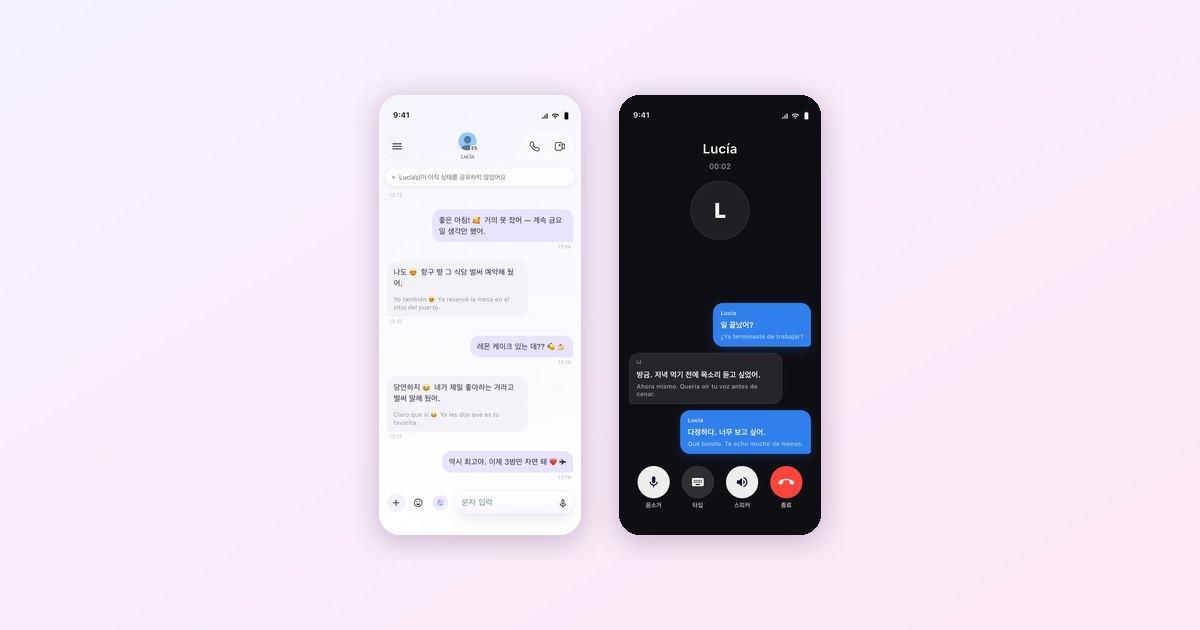
The practical fix is keeping translation inside the conversation rather than beside it. In Heartline, you write English and they read Korean in the same bubble, both versions visible, voice notes translated too — which matters more than you'd think in a voice-note-heavy culture.


The time-zone problem is really a call problem
Korea sits 13 to 17 hours ahead of North America, so if you're in the long-distance phase, scheduling is half the relationship. Anchor calls to routines instead of clock times. "My coffee, your dinner" survives daylight saving better than "9 PM Tuesday."
The other half is what happens on the call itself. Emotional conversations conducted in one partner's second language, late at night, tired: that's how small things become fights. Live-translated calls change the equation: each of you speaks your own language and reads the other's in real time. Save the English practice for good days. For the conversation about where this is going, be fluent.
(Every couple fights. For that part, we wrote a separate piece on arguing fairly across languages.)
Meeting Korean parents
Treat it as a bigger milestone than you think it is. The formality is the point: use two hands when you give or receive anything, bow with your 안녕하세요, bring a considerate gift, wait for the eldest person to lift their spoon first. Expect direct questions — your job, your plans, your intentions — that would feel forward back home. That's interest, not interrogation.
Your partner will interpret the important parts. For the stretches when they can't, a translation app sitting openly on the table works better than silent smiling, and parents consistently read it as effort.
About actually learning Korean
Korean is one of the hardest languages for English speakers; the usual estimate is 2,200+ study hours. Nobody's asking you to do that before the third date. Do learn Hangul, though. The alphabet genuinely takes a weekend, and it unlocks menus, street signs, and a surprising amount of goodwill.
For everything else, the pattern from our cross-language playbook holds: study slowly because you want to, and let real-time translation carry the daily weight so nobody has to perform a second language while tired, sick, or upset.
The subtitles were a fine way in. Everything after that gets built in the ordinary back-and-forth of two people actually understanding each other.
Heartline provides real-time translation for text, voice, and video calls — built specifically for cross-language couples. Available free on iOS and Android.
Frequently asked questions
Do I need to learn Korean to date a Korean speaker?
Not to fluency — Korean takes 2,200+ study hours for English speakers. Learn Hangul (the alphabet) in a weekend for enormous goodwill and practical use, keep learning gradually, and let real-time translation handle daily conversations so nobody waits for fluency.
What are Korean speech levels and do they matter for our relationship?
Korean has formal (jondaemal) and casual (banmal) registers. Your partner using banmal with you signals intimacy; their parents expecting jondaemal signals respect. English flattens this distinction, so knowing it exists helps you read moments that translation can't carry.
Why does my Korean partner text so frequently?
Frequent short check-ins are normal relationship maintenance in Korean texting culture — quick messages, ㅋㅋㅋ, stickers, and voice notes. Going quiet for a day can read as distance. Matching the rhythm, even with short translated replies, keeps the connection warm.
What should I know before meeting Korean parents?
Use two hands when giving or receiving anything, greet with a bow and 'annyeonghaseyo,' bring a considerate gift, wait for the eldest to start eating, and expect direct questions about your job and intentions — that's interest, not interrogation.
How do we handle calls across the Korea time-zone gap?
Anchor calls to daily routines rather than clock times, and use live-translated voice or video calls for anything emotional. Heartline shows live subtitles in both languages during the call, so each of you speaks naturally in your own language.
Try Heartline for free
Love speaks every language. Text, voice and video — translated in real time.