Table of contents
Your phone buzzes. It's her reply to the trip you proposed: ちょっと難しいかも — "it might be a little difficult." You stare at it. Difficult how? Difficult like we should book earlier, or difficult like she doesn't want to go?
If you're dating someone who speaks Japanese, you already know this moment. Most advice assumes the problem is vocabulary. The harder problem is that Japanese and English carry meaning in different places.
Where the meaning actually lives
Japanese conversation puts a lot of weight on what isn't said. Refusals get softened until they barely look like refusals, so "it might be a little difficult" very often means no, said kindly. Disagreement arrives as a pause, a hedge, a change of subject. There's a phrase for the skill of picking all this up: 空気を読む, reading the air.
None of this means your partner is being evasive. It means a word-for-word translation can be accurate and still wrong. The words made it across; the signal didn't.
You don't fix this with fluency. You fix it by knowing the pattern exists, and by asking one more gentle question when something feels ambiguous. "Do you mean it's tricky but doable, or would you rather skip it?" works in any language. This is the part most language-barrier advice skips past.
Texting is where it lives or dies
Day to day, a cross-language relationship mostly happens in a chat thread. Which is unfortunate, because the copy-paste routine (read, switch apps, paste, translate, type, translate back, paste, send) kills spontaneity. By the time you've translated a joke, it isn't one anymore.
A few things I'd tell a friend in this situation:
Keep messages short and single-topic. Long paragraphs multiply the ways a translation can wobble.
Watch the emoji. Japanese texting leans on softeners, and a message that ends bare can read colder than you meant it. Notice what your partner uses and mirror it a little.
Don't spiral over short replies. うん ("yeah") is a warm, normal answer, not a brush-off.
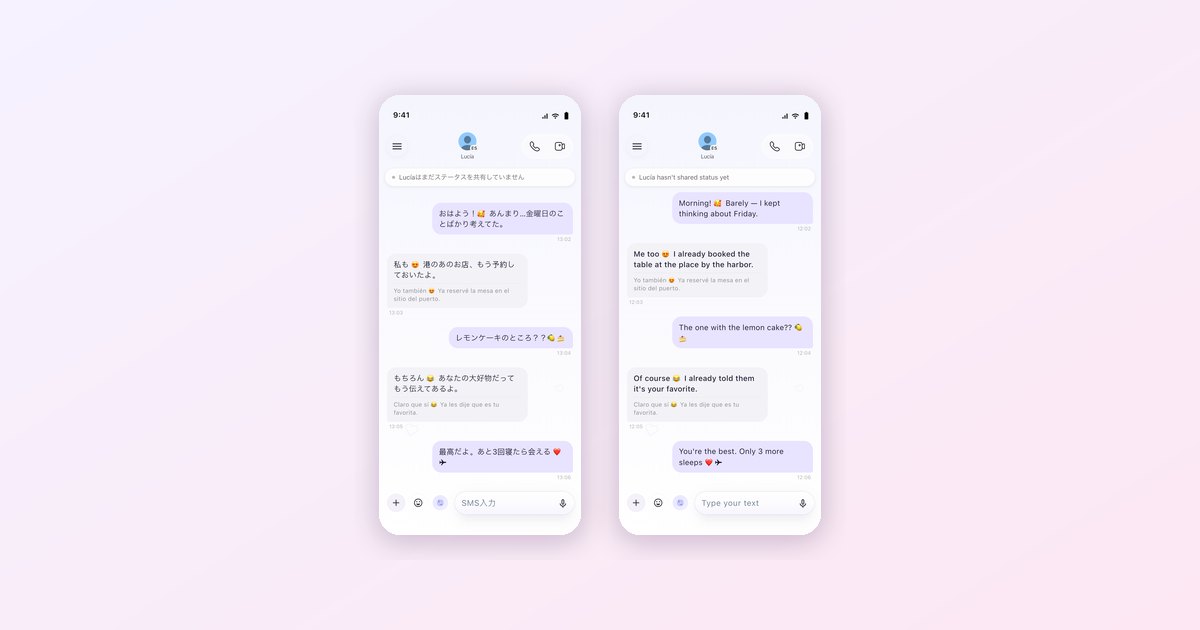
And get the translation inside the conversation instead of next to it. In Heartline, you type English and she sees Japanese in the same bubble, with your original right above it. Nobody leaves the chat, and nobody loses the nuance of what was actually written.

Calls are where it gets real
Texting keeps a relationship running. Voice is what makes it deepen. If you're doing the long-distance stretch, and a lot of couples who met while traveling are, calls basically are the relationship for months at a time.
The trap most couples fall into is speaking slow, simplified English on every call. It feels considerate. But it quietly makes one person perform in their second language every single day, and that asymmetry builds resentment over time, usually on both sides.
What works better: let each person speak their own language. Heartline's voice and video calls show live translated subtitles for both sides, so she can be fully herself in Japanese and you still follow in real time. The first time you hear your partner being genuinely funny in her own language, you understand what the slow-English calls were costing you.
Time zones are their own battle — Japan to the US or Europe is brutal — so anchor a short call to a daily routine instead of chasing a perfect two-hour window.
Meeting the family
If it gets serious, one day you'll sit at a table in Osaka or Saitama where everyone speaks Japanese and you'll understand roughly nothing. It's fine. Nobody there expects the foreign partner to speak Japanese, which means the little you do say counts double.
Learn a handful of phrases until they survive nerves: はじめまして (nice to meet you), お邪魔します (said when entering the home), ごちそうさまでした (after the meal). Bring a small gift from your hometown. 手土産 is close to mandatory, and a story attached to it beats an expensive one. Ask your partner to brief you on the family's formality level before you walk in, not after.
And keep a translation app within reach for the moment your partner disappears into the kitchen and you're alone with her father. We wrote a whole guide on meeting the parents across a language barrier, because that moment deserves its own playbook.
Do you have to learn Japanese?
Eventually, some. Honestly, learning even a little will move your partner more than almost anything else you can do. But conversational Japanese is a 2,000-hour project for English speakers, and your relationship is happening now.
So run both tracks. Study when you can, because you want to. Let real-time translation carry the daily load in the meantime, so neither of you is waiting for fluency to feel close. That's the whole argument of our cross-language relationship playbook: the tools aren't a crutch, they're the bridge you stand on while you build the rest.
The couples that don't make it usually didn't fail at Japanese. They failed at noticing that "it might be a little difficult" was an answer.
Heartline provides real-time translation for text, voice, and video calls — built specifically for cross-language couples. Available free on iOS and Android.
Frequently asked questions
Do I need to learn Japanese to date someone who speaks it?
No. Conversational Japanese takes 2,000+ study hours for English speakers, and your relationship is happening now. Learn it gradually because you want to — your effort will be genuinely appreciated — but use real-time translation to carry the daily conversation load in the meantime.
Why does my Japanese partner seem indirect or vague in texts?
Japanese communication culture often expresses disagreement or refusal softly — 'it might be a little difficult' frequently means 'no,' said kindly. A literal translation preserves the words but drops that signal. Knowing the pattern, and asking gentle clarifying questions, prevents most misunderstandings.
What's the best way to text with a Japanese-speaking partner?
Keep messages short and single-topic, mirror their emoji use, and use in-line translation instead of copy-pasting between apps. Heartline shows your original and the Japanese translation together in the same chat, so nuance stays visible to both of you.
What should I do when meeting Japanese parents for the first time?
Learn a few key phrases (hajimemashite, ojama shimasu, gochisousama deshita), bring a small gift from your hometown (temiyage), have your partner brief you on the family's formality level, and keep a translation app ready for moments when your partner steps away.
Can we have real phone or video calls if we don't share a language?
Yes. Heartline translates voice and video calls in real time with live subtitles for both sides, so each of you speaks your own language naturally. This works far better for emotional conversations than one partner performing slow, simplified English.

Try Heartline for free
Love speaks every language. Text, voice and video — translated in real time.