Table of contents
The first few calls with someone who doesn't share your language go one of two ways. Either you both speak slow, careful English and one of you is exhausted after twenty minutes, or you keep a translation app open and spend the call looking at it instead of at each other.
Heartline's calls are built so neither has to happen. You talk in your language, they talk in theirs, and captions in both languages appear on the call as you speak.
Voice calls
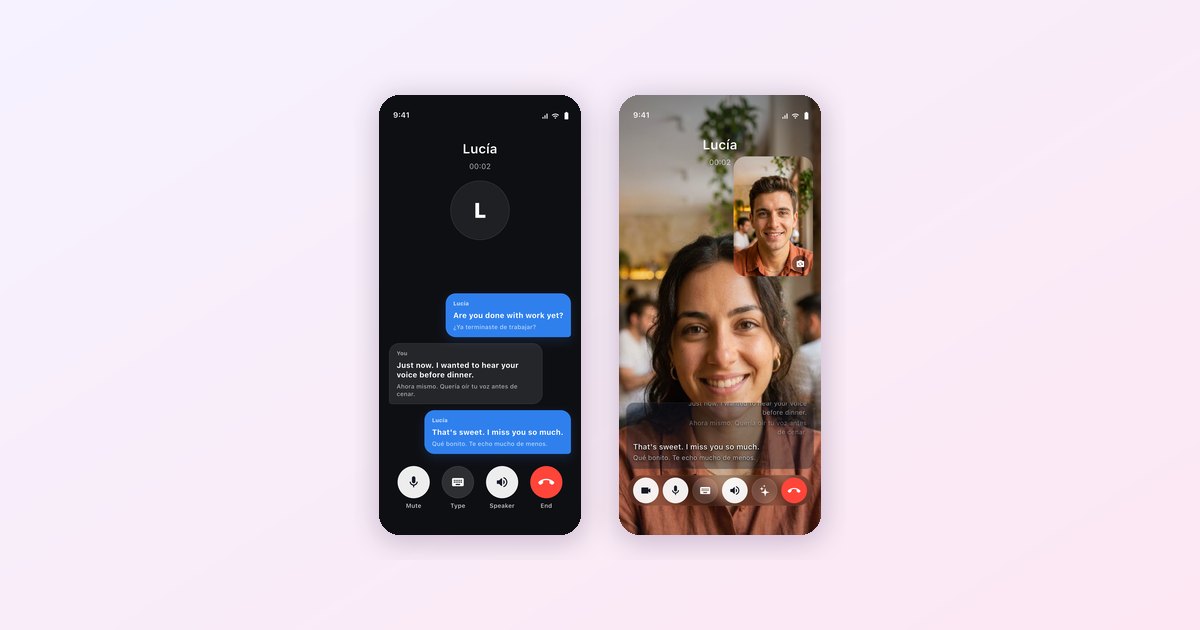
On a voice call the screen turns into a running transcript. Each turn shows what was said and the translation under it, labeled by who said it.

So when Lucía asks "¿Ya terminaste de trabajar?", you read "Are you done with work yet?" and answer in English. She sees your answer in Spanish. Nobody waits for a sentence to finish being typed.
There's also a Type button on the call. Sometimes a word won't come out right, or you're somewhere you can't talk out loud. You can type a line mid-call and it gets translated and shown to your partner like everything else.
Video calls
Video works the same way, with the subtitles at the bottom of the picture so you can watch your partner's face while you read. That matters more than it sounds. Much of what makes a conversation feel intimate is expression, and it's hard to catch a smile when your eyes are on a translator in another window.
Your own words are subtitled too, so you can check that what you meant is what got through. If a translation comes out odd, you'll see it at the same moment they do, and you can laugh about it and rephrase.
What it changes
The biggest difference isn't accuracy. The less fluent partner gets to be themselves on calls. They can be funny, precise, or just tired in their own language, instead of performing a simplified version of themselves in a second one. Over months that adds up. One partner stops being the permanent interpreter, and arguments get easier to have fairly (we wrote about that in arguing across languages).
It also makes some calls possible that weren't before, like a first video call with your partner's parents. Our guide to meeting the parents without a shared language covers how couples use it for that.
When to use it and when not to
You don't have to translate every call. If you're both practicing a language and having a good day, turn the effort up and speak in it. Keep translation for the calls that matter: the plans, the misunderstandings, the conversation about where this is going. Our long-distance guide goes into how couples split that.
Heartline provides real-time translation for text, voice, and video calls — built specifically for cross-language couples. Available free on iOS and Android.
Frequently asked questions
Does my partner need to speak my language for Heartline calls?
No. Each of you speaks your own language and live captions show both the original and the translation.
Can I type during a call?
Yes. The Type button lets you send a line mid-call; it is translated and shown to your partner.
Do video calls have subtitles?
Yes. Translated subtitles appear at the bottom of the video so you can read while watching your partner.

Try Heartline for free
Love speaks every language. Text, voice and video — translated in real time.